Governments worldwide are introducing regulatory standards to promote sustainability. These changes are reshaping industries, particularly in manufacturing and distribution, by emphasizing transparency, circularity, and accountability.
In this dynamic environment, digital labels are emerging as a crucial tool for ensuring compliance and achieving sustainability goals.
What are some of the major emerging regulations?
New regulations surrounding sustainability are emerging globally. No matter where your company is based, staying compliant is crucial for international trade. Let’s take a look at three major initiatives below:
EU’s Digital Product Passport (DPP)
The European Union is mandating that goods have a Digital Product Passport (DPPs). This mandate applies to any goods sold in the EU’s market — regardless of production origin. The rollout prioritizes items with significant environmental impact, like textiles.
The first phase, enacted in 2027, requires a DPP to include core product details. By 2030, the scope will expand to enhance transparency and accountability with supply chain and after-sales tracking. Looking ahead to 2033, the vision is a "full circular DPP" that fully integrates the EU’s sustainability and circularity standards.
California’s Extended Lifecycle Legislation (SB 707)
California’s Senate Bill 707 is following in the footsteps of previous EU legislation, requiring textile manufacturers to take responsibility for their products’ entire lifecycle. By 2026, the current bill requires manufacturers to form a Producer Responsibility Organization (PRO) to manage product collection, repair, and recycling. Approved plans must be submitted by 2030.
The plan should prioritize repair and reuse as waste management mechanisms, with recycling as an alternative. It must also include provisions for consumer education about collection sites and the purpose of PROs. Additionally, annual financial and waste management reports detailing collection and reuse/recycling efforts must be submitted.
GAO Report on Textile Waste
California’s sustainability leadership often sets the tone for broader U.S. adoption. The Government Accountability Office (GAO) recently released its first official report on the costs of textile waste. It includes recommendations for agencies like the EPA and the U.S. Department of Energy to manage textile waste effectively.
The report advises Congress to direct federal entities to coordinate efforts to reduce textile waste and advance recycling initiatives. Although no federal legislation exists yet, these recommendations are designed to guide future legislation.
What’s a digital label?
Regardless of the legislation’s origin, digital labels are essential tools that help your company meet regulatory standards. Digital labels integrate physical product labels with advanced digital technologies to provide detailed, interactive information.
These labels streamline compliance, enhance transparency, and foster sustainable practices for companies and consumers.
How does digital labeling enable compliance?
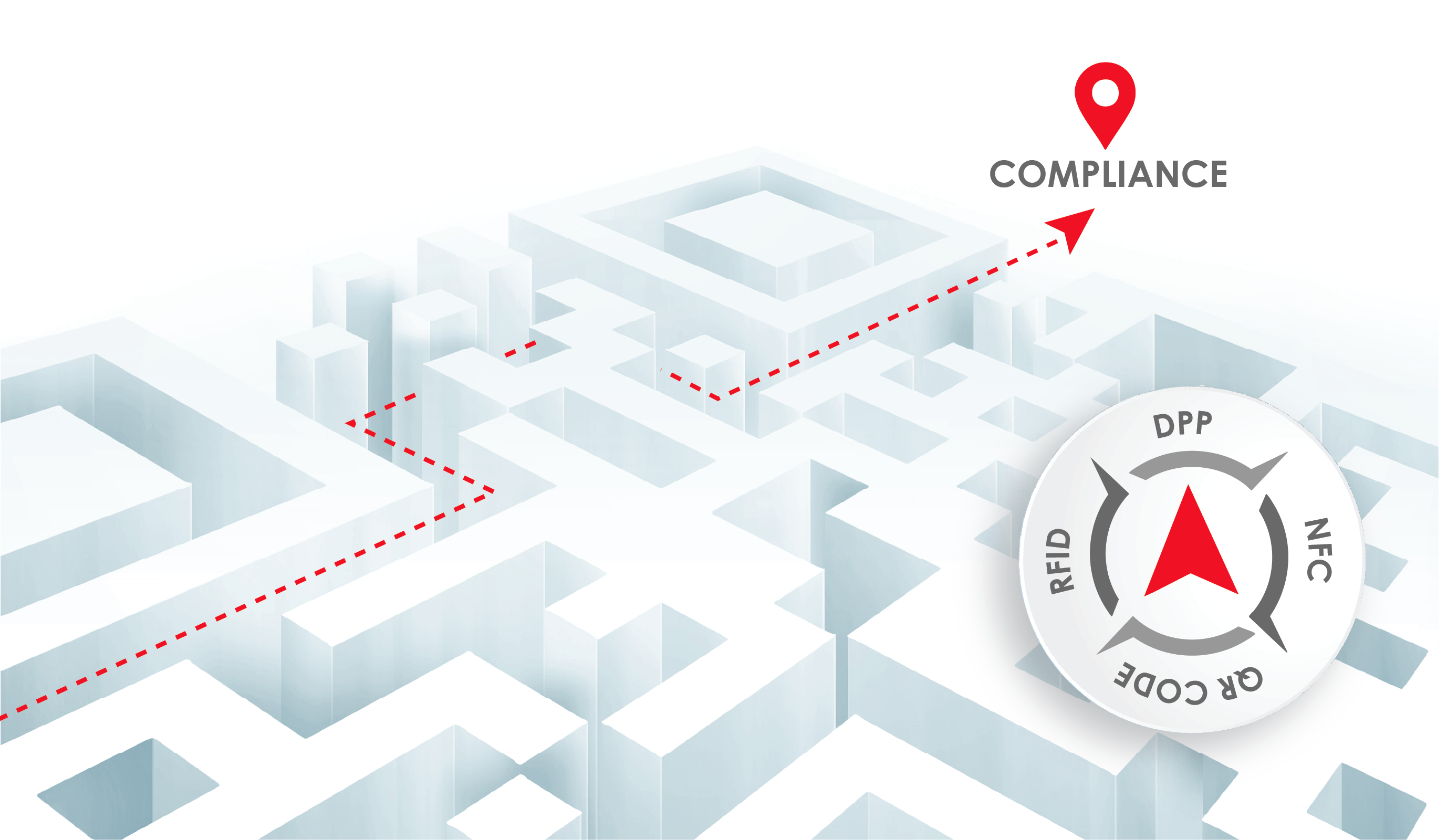
Digital labeling technologies like Radio Frequency Identification (RFID), Digital Product Passports (DPPs), and NFC/QR codes each serve unique functions that enable your company to adapt to regulations.
RFID
RFID technology offers a seamless, accurate, and efficient solution for managing inventory and tracking products throughout your supply chain. By reducing human involvement and error, RFID quickly tracks inventory with 99.9% accuracy.
When integrated into an RFID management system like Truecount, the technology enables real-time tracking, providing full visibility into your supply chain. This delivers accurate and verifiable data on ethical sourcing, transparency, and traceability, which are essential for meeting many sustainability regulations including the EU’s DPP mandate.
DPPs
Digital Product Passports, like those offered through Charming.DIGI, serve as comprehensive digital records that store product information, including material composition, recyclability, and environmental impact. This is an excellent way to deliver data collected via RFID directly to consumers. In regions like the EU, DPPs are becoming necessary for compliance.
Also, DPPs provide a valuable platform for educating consumers on caring for, reusing, recycling, and reselling their garments. This feature is super helpful in areas like California, where regulations emphasize consumer education.
By promoting transparency, businesses not only meet regulatory requirements but also enhance customer trust and loyalty.
NFC/QR Codes
Technologies like NFC and QR codes deliver instant access to product details through a simple smartphone tap or scan. These technologies can link products directly to their DPP.
This seamless access to information is increasingly important as companies face growing responsibility for their products beyond production and distribution. Offering consumers a user-friendly way to learn about product care, repair, and disposal is essential for extending product lifespans and promoting sustainable practices.
With the EU’s DPP mandate and California’s SB 707 emphasizing consumer access to information, NFC and QR codes provide the most straightforward and effective solution.
Moving towards compliance
Each digital label serves a unique function, and companies can maximize their effectiveness by employing multiple digital labeling technologies. As global regulations evolve, digital labels have become indispensable for businesses aiming to stay compliant and competitive.
To further explore compliance strategies, join industry leaders at the American Apparel & Footwear Association (AAFA) event on Wednesday, February 5, 2025 and Thursday, February 6, 2025.


.png) Rich Ringeisen
Rich Ringeisen

.png?width=30&name=rich%20ringeisen%20-%20Edited%20(1).png) Rich Ringeisen : Mar 26, 2025, 12:00:00 AM
Rich Ringeisen : Mar 26, 2025, 12:00:00 AM


.png?width=30&name=CT%20SLASH%20(1).png) CHARMING STAFF
CHARMING STAFF