It’s no secret that the fashion industry continues to find itself at a crossroads, grappling with ever changing sustainability and circularity requirements. Let’s dive into the key problems brands face as policies change and explore why a digital product passport solution emerges as a critical tool—both from an environmental compliance standpoint and to help the industry achieve a more sustainable future.
The Complex Landscape of Sustainability Mandates
With a constant barrage of sustainability policies being unveiled across different regions, brands that operate globally need to start embracing more stringent mandates ranging from raw material sourcing to manufacturing processes and end-of-life product management.
A recent McKinsey Study highlights that new sustainability rules in the European Union and the US will require brands to heighten their focus on cutting greenhouse gas emissions and waste while revamping their business models to protect and preserve natural resources.
From a compliance standpoint, chances are brands will be better served to start adhering to stricter guidelines now to avoid disruptions to supply chain processes later. In particular, brands should focus on these three areas:
1. Supply chain transparency:
The opacity of supply chains remains a significant hurdle, making it difficult for consumers and stakeholders to trace the origin of materials and verify ethical practices.
2. Waste management: The fashion industry is notorious for its contribution to global waste, with fast fashion cycles leading to vast amounts of discarded clothing. Proper disposal and recycling mechanisms are critical to mitigate environmental impact.
3. Resource depletion: Traditional manufacturing practices often exploit natural resources, contributing to deforestation, water pollution, and other forms of environmental degradation.
The role of digital passports in addressing sustainability challenges
In the face of these challenges, a digital product passport (DPP) emerges as the ideal solution to ever-changing guidelines. The DPP will ultimately transform how the fashion industry operates as a whole.
But what is a digital product passport?
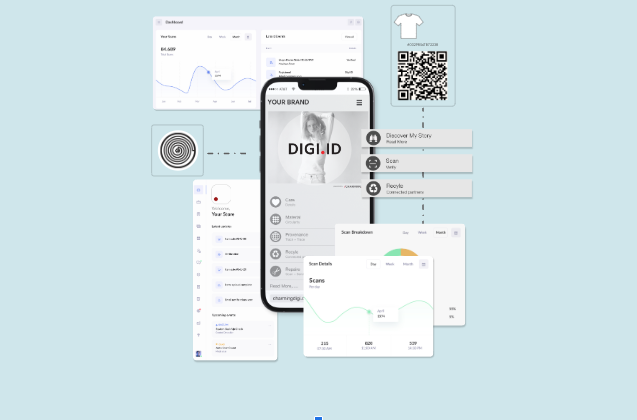
A digital product passport (DPP) is a digital repository that collects and shares data about a product's materials, supply chain, and environmental impact. For example, a consumer can scan a QR code embedded into the label of an item and immediately access a Digital Product Passport that includes critical sustainability and compliance issues. DPPs help with a variety of factors, including:
- Traceability and transparency: Digital passports enable real-time tracking of a product's journey from raw material to end consumer. This creates a sense of trust, allowing consumers to make informed choices aligned with their values.
- Lifecycle management: By incorporating information on the product's materials and recyclability, DPPs empower brands and consumers to make sustainable choices. This data can guide consumers on proper disposal methods and incentivize circular practices, particularly when it comes to reselling.
- Reduction of unnecessary waste: Instead of producing elaborate hang tags and labeling to tell a product’s sustainability story and journey, DPPs allow brands to update sustainability messaging and stories on the fly, without having to exhaust costly and time-consuming printing resources.
- Authentication of sustainable practices: A digital passport can serve as a certification of a brand's commitment to sustainable and ethical practices. This verification can be a powerful marketing tool, attracting eco-conscious consumers. It can also be leveraged to validate product authenticity.
- Regulatory compliance: As governments worldwide intensify and update their focus on environmental regulations, DPPs can help brands avoid costly fines and give them easier to update their customer communications as policies evolve.
- Renewed focus on brand: According to that same McKinsey study, “71 percent of executives plan to spend more on brand marketing than in 2023 in a bid to cultivate emotional connections with customers.” In a world where customers are increasingly environmentally conscious and sensitive to greenwashing, leveraging DPP to tell your brand’s sustainability story—and make changes on the fly—becomes an up-and-coming CSR marketing machine.
- Trust: You and your organization have spent a lot of time and resources in moving towards a more sustainable product. The DPP helps you prove it—and communicate it to your customers.
DPPs: A clear path forward
As the fashion industry rushes to address sustainability scrutiny, the integration of digital product passports isn’t just a strategic decision. Soon, it’ll be a regulatory non-negotiable.
But Neil Greenhalgh, the Director of Digital Solutions at Charming Trim, shared that there are more advantages to DPP integration than just compliance.
“Our customers are concerned about compliance, but there’s also an emerging realization that brands’ customers of the future—Gen Z and beyond—are digitally native, and the DPP is a great way of digitally interacting with them,” Greenhalgh explained.
By transitioning to DPPs, smart brands can do more than align themselves with sustainable practices. Early adoption of the DPP positions brands as leaders in an industry that is undergoing a paradigm shift towards greater environmental good.
To learn more about how Charming.DIGI x Tappr can help you bring your digital product passport to life, request a demo with our team. Stay ahead of the curve and start building your DPP today.
Editor’s note: This content was updated on October 1, 2024.

.png) Rich Ringeisen
Rich Ringeisen

.png?width=30&name=Untitled%20design%20(16).png) Andy Van Duyse : Apr 11, 2025, 12:00:00 AM
Andy Van Duyse : Apr 11, 2025, 12:00:00 AM

 Jeremy Van Houten
.png?width=30&name=CT%20SLASH%20(1).png) CHARMING STAFF
CHARMING STAFF