 Jeremy Van Houten
1 min read
When Is It Time for a Rebrand?
.png?width=30&name=rich%20ringeisen%20-%20Edited%20(1).png) Rich Ringeisen : Sep 23, 2024, 12:00:00 AM
Rich Ringeisen : Sep 23, 2024, 12:00:00 AM
Every clothing company's brand identity is woven into the fabric of its products. However, as business evolves, the brand image may start to fray....

Discover upcoming exhibitions, conferences, webinars, and industry events where you can connect with our team, explore new solutions, and learn about the latest trends in the market.

With an increasing number of consumers willing to spend more for products they believe to be more sustainable, it can be tempting to focus your marketing and messaging efforts on the most eco-friendly aspects of your products.
Unfortunately, that is often the first step onto the slippery slope of greenwashing: making unsubstantiated claims that can mislead consumers into believing that a company’s products are more environmentally friendly than they really are.
The term “greenwashing” was first coined by environmentalist Jay Westerveld in a 1986 essay about the hotel industry's practice of placing notices in bedrooms promoting the reuse of towels to "save the environment.”
In his essay, Westerveld noted that often little or no effort toward reducing energy waste was made by these institutions, although towel reuse saved them laundry costs. He concluded that often the real objective was increased profit, and labeled this and other profitable-but-ineffective "environmentally-conscientious" acts as greenwashing.
When you consider the data, the motivations behind greenwashing become very clear.
As far back as 1991, studies found that the environmental reputation of a company affected a consumer’s purchase intent. And today, according to GreenPrint’s 2021 Business of Sustainability Index, 64% of Gen X consumers would spend more on a product if it comes from a sustainable brand, with that number jumping to 75% among millennials.
A clear argument for greenwashing emerges — but it only harms consumers.
Greenwashing can take many forms. From false claims of improved environmental friendliness to messaging that can’t be substantiated with actual data to leveraging images or attestations that imply sustainability, greenwashing has no industry or geographical barriers. And consumers are sitting up and taking notice – and sometimes taking legal action as well:
Starbucks faced claims of greenwashing in 2018 when it introduced a lid with a built-in drinking straw that – despite being recyclable, unlike its predecessor – actually contained more plastic by weight than the old straw and lid together.
In April 2022, some items advertised by Kohl’s and Walmart as “bamboo” were actually made of rayon. As a result, both retailers were fined for a total of $5.5 million in civil penalties for violating the FTC Act and the Textile Act.
And this year, Lululemon met scrutiny by the Canadian government for their “Be Planet” campaign. With sweeping claims of environmental activism and limited support to back it up, the athletics brand is under investigation. While there’s been no conclusion to the case yet, Lululemon is a key example of the emerging reality that it’s more important than ever to back up your environmental claims.
While these are high-profile examples, the greenwashing story plays itself out daily, with far-reaching and negative consequences. Greenwashing undermines the legitimate efforts of companies genuinely trying to be environmentally responsible. In some cases, greenwashing can have legal consequences; in the United States, for example, the Federal Trade Commission (FTC) has the authority to take action against companies that make false or misleading environmental claims.
And of course, there is the hit to your brand reputation — and your organization’s bottom line — that comes with this sort of behavior.
So, how can you champion true sustainability within your organization and avoid the PR and legal ramifications of greenwashing?
Like with most things in life, honesty is the best policy. Charming’s president, Rich Ringeisen, puts it simply, saying: “Keep it simple, set goals, achieve them, tell the truth, and inform your customers. There’s no need to overthink it.”
Be transparent. Provide clear and specific information about the environmental impacts of your products and your company’s operations. This includes disclosing any negative environmental impacts as well as any positive ones.
Consider using valid third-party attestations and certification programs to verify your environmental claims. Below, you’ll see all of the certifications Charming Trim has earned, as an organization committed to true sustainability.
.png?width=1260&height=222&name=Charming%20Certificates%20(5).png)
Finally, we recommend making a genuine effort to continuously improve the environmental performance of your products and operations. Set goals and pay attention to regulation roll-out timelines so that you’re always moving in the right direction.
We’ve been at this for a while and we know sustainability can feel like a buzzword — but it’s not going away. Our organization is committed to making it easier for you to meet your green goals.
From recycled labels to sustainable stickers on eco-friendly sticker paper, eco-friendly hang tags, e-commerce packaging, and everything in between, you can count on us to help you navigate the complexities surrounding sustainable packaging and labeling.
Plus, we step up sustainability by making it smart. Our greener RFID products dramatically reduce the amount of single-use materials and up your tech game, and Charming.DIGI makes it easy for you to communicate your product’s sustainability story with your customers.
With decades of experience helping some of the biggest retail brands navigate the world of sustainability –– responsibly –– we can help.
Editor’s note: This content was originally published on January 9, 2023, but was refreshed and updated on October 11, 2024.

1 min read
Rich Ringeisen : Sep 23, 2024, 12:00:00 AM
Every clothing company's brand identity is woven into the fabric of its products. However, as business evolves, the brand image may start to fray....
1 min read
 Neil Greenhalgh : Sep 11, 2024, 12:00:00 AM
Consumers are driving the change for better transparency when it comes to the products they purchase. Whether it’s a brand-new product or a...
1 min read
.png?width=30&name=Untitled%20design%20(16).png) Andy Van Duyse : Jan 2, 2025, 12:00:00 AM
Andy Van Duyse : Jan 2, 2025, 12:00:00 AM
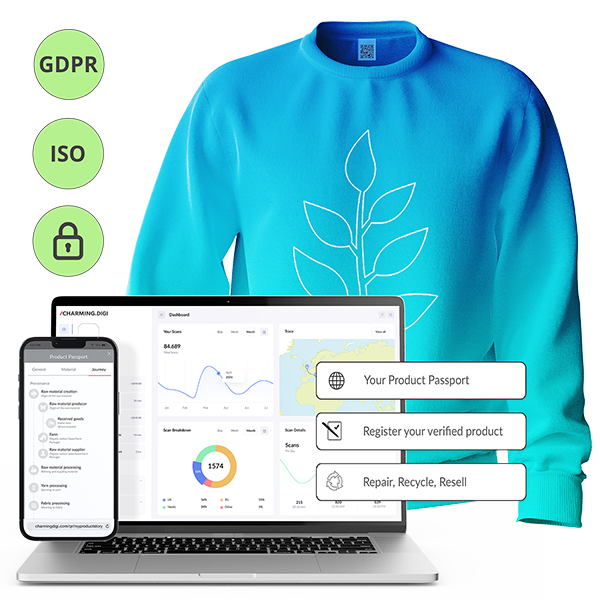
You can think of the digital product passport (DPP) as a digital filing cabinet — it safely stores the most important product data for individual...