Tags are itchy, annoying, and always seem to pop out of your collar at the worst times. But beyond the everyday inconvenience, traditional garment labels have bigger issues: they’re costly, inefficient, and environmentally wasteful. Yet, they’re still required under the Textile and Wool Acts and the Care Labeling Rule.
To tackle these challenges, the American Apparel & Footwear Association (AAFA) has submitted a petition pushing for digital labels as a valid alternative. This proposal seeks to modernize the way required information is delivered, creating a better experience for both consumers and manufacturers.
The problem with physical labels
The current labeling system imposes significant costs on manufacturers. The companies subject to the Care Labeling Rule collectively spend $34 million annually to determine care instructions, $17 million to draft and order labels, and $166 million to attach them. This totals $217 million per year, and that doesn’t even include printing expenses.
Beyond the financial burdens, physical labels contribute to environmental waste. The apparel industry generates 5.7 million miles of label tape annually, much of which ends up in landfills. Printing these labels also requires large amounts of ink and electricity, further impacting sustainability efforts.
Even after reaching the consumer, most labels are quickly removed due to discomfort and lack of usefulness. Care instructions are often crammed into tiny, unreadable text alongside confusing symbols, making them difficult to understand.
The AAFA’s petition for digital labels
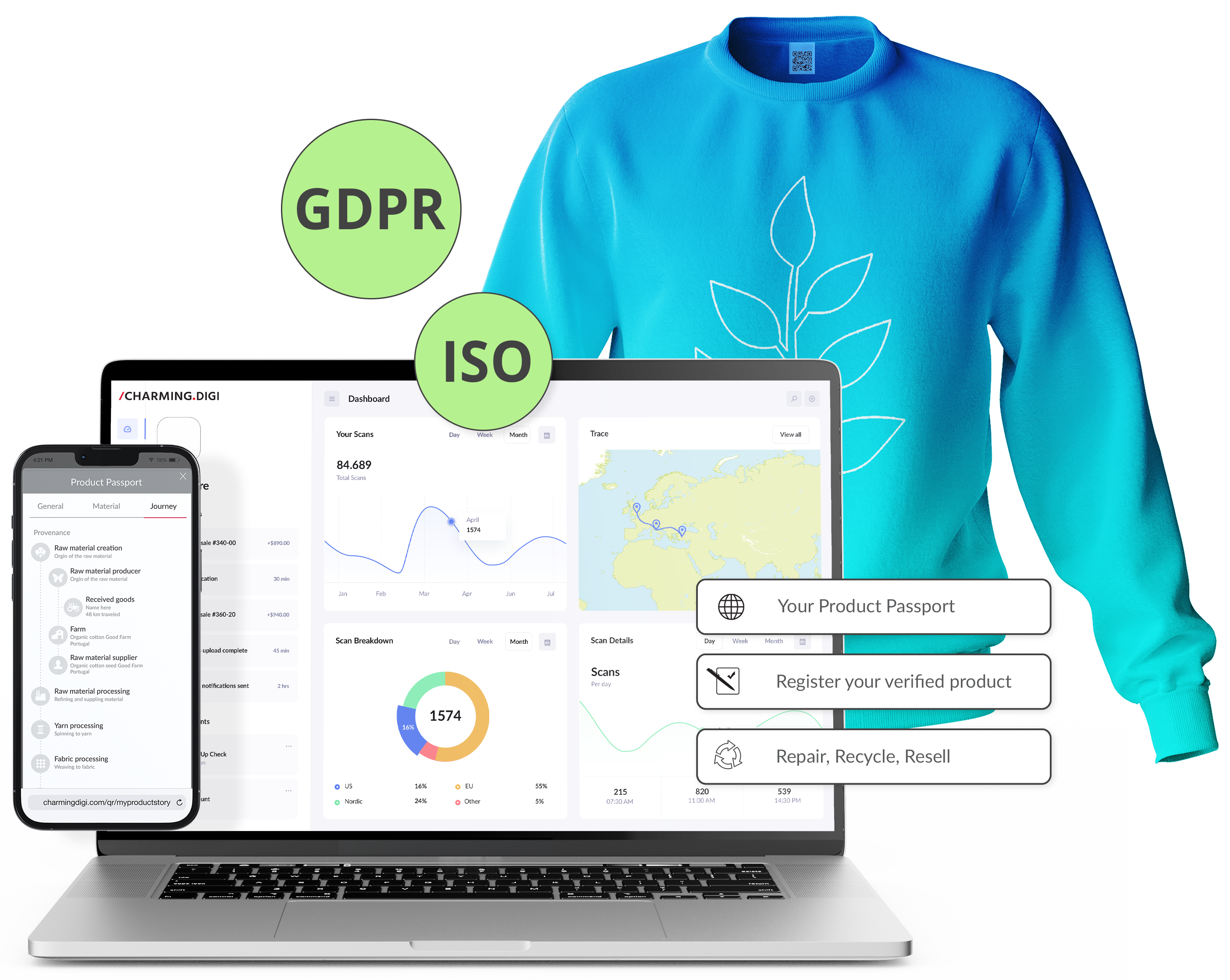
These issues can be resolved by using digital labels. The AAFA's petition proposes that manufacturers should be able to use digital labels to convey care instructions instead of the traditional physical label. The digital label would be accessible through a QR code, which could be printed directly on the garment or included on a small, non-bulky tag.
To be clear, the petition only suggests expanding what qualifies as a care label — it’s not looking to change the actual content that’s already required.
The benefits of digital labels
Shifting to digital labels offers numerous advantages for both businesses and consumers. Digital labels solve the problems of physical labels and even offer features that traditional labels never could.
Digital labels dramatically reduce production costs. They are cheaper to design, create, and maintain than physical labels. Smaller, ink-efficient tags lower printing expenses, and since the information is web-based, updates can be made easily without costly reprints. These company savings can also be passed onto consumers.
Additionally, the environmental benefits are substantial. Eliminating physical labels would significantly reduce waste and cut at least 343,000 metric tons of CO₂ emissions from industry supply chains. Plus, reducing the need for printing lowers water consumption and water pollution.
Finally, digital labels are more functional. The digital format allows for larger fonts and clearer instructions. Manufacturers would be able to provide instructions in multiple languages and ensure accessibility for visually impaired users. Unlike physical labels, which are static, digital labels can be updated as needed.
The timeline
So when would the regulation change? The AAFA submitted the petition on February 28, 2024. The Federal Trade Commission (FTC) must now review the proposal to determine whether it falls within its jurisdiction, which it should be. (The AAFA has already prepared a memorandum outlining why the FTC has the authority to oversee digital labeling for textile and wool products.)
If the FTC confirms jurisdiction, it will open a public comment period lasting 30 to 60 days, allowing industry stakeholders, consumer advocacy groups, and the public to provide input. Following this phase, the FTC may request modifications before proceeding with a formal rulemaking process.
The future is digital
This regulation change would allow manufacturers to meet care label requirements while boosting efficiency. But digital labels go beyond just compliance; they improve the consumer experience and create new marketing opportunities.
Many companies are already enjoying the benefits of digital labels, and we’re here to help you do the same. Ready to make the switch? Schedule a consultation with us today!

.png) Rich Ringeisen
Rich Ringeisen

.png?width=30&name=rich%20ringeisen%20-%20Edited%20(1).png) Rich Ringeisen : Jun 1, 2026, 12:00:00 AM
Rich Ringeisen : Jun 1, 2026, 12:00:00 AM

.png?width=30&name=CT%20SLASH%20(1).png) CHARMING STAFF
CHARMING STAFF