For decades, the humble care label has been a boring necessity, resting inconspicuously inside your garments. Between the abstract care symbols and generic origin attribution, there was never a real need to take too much time inspecting the label.
But with emerging regulations and improved technologies, the care label has the potential to become a brand asset that’s far from humble. It can serve as a bridge between your garments and your brand, checking important compliance boxes—all while telling your brand’s story. Here’s how you can get the most out of your smart care label:
The push for digital care labels
Whether your brand is based in North America, Europe, or beyond, the global push for increased production transparency is growing in pressure. While the inclusion of your product’s journey and recycling details was once a “nice-to-have,” it won’t be long before it’s a requirement.
California has been pushing hard on environmental and recycling laws and regulations, and the Responsible Textile Recovery Act of 2024 has officially entered law. Even if you’re not a California resident, this act is still likely to have an impact on you. Rich Ringeisen, the President of Charming Trim, shared his perspective on the effects of the act:
“Love it or hate it, California has the largest population in the USA—and one of the biggest economies in the world. These emerging regulations aren’t just going to affect California businesses. They will have an effect on all brands that market and sell to anyone within the state.”
He went on to explain that, when you take into account EU laws as well, communicating transparently with your customer is becoming a non-negotiable.
Care labels are more than just fabric instructions
Sure, transparency is growing in its importance—but what does that have to do with the care label or competitive advantage?
And no—we’re not talking about a miles-long care label that customers are certainly going to cut out. We’re talking about the digital product passport.
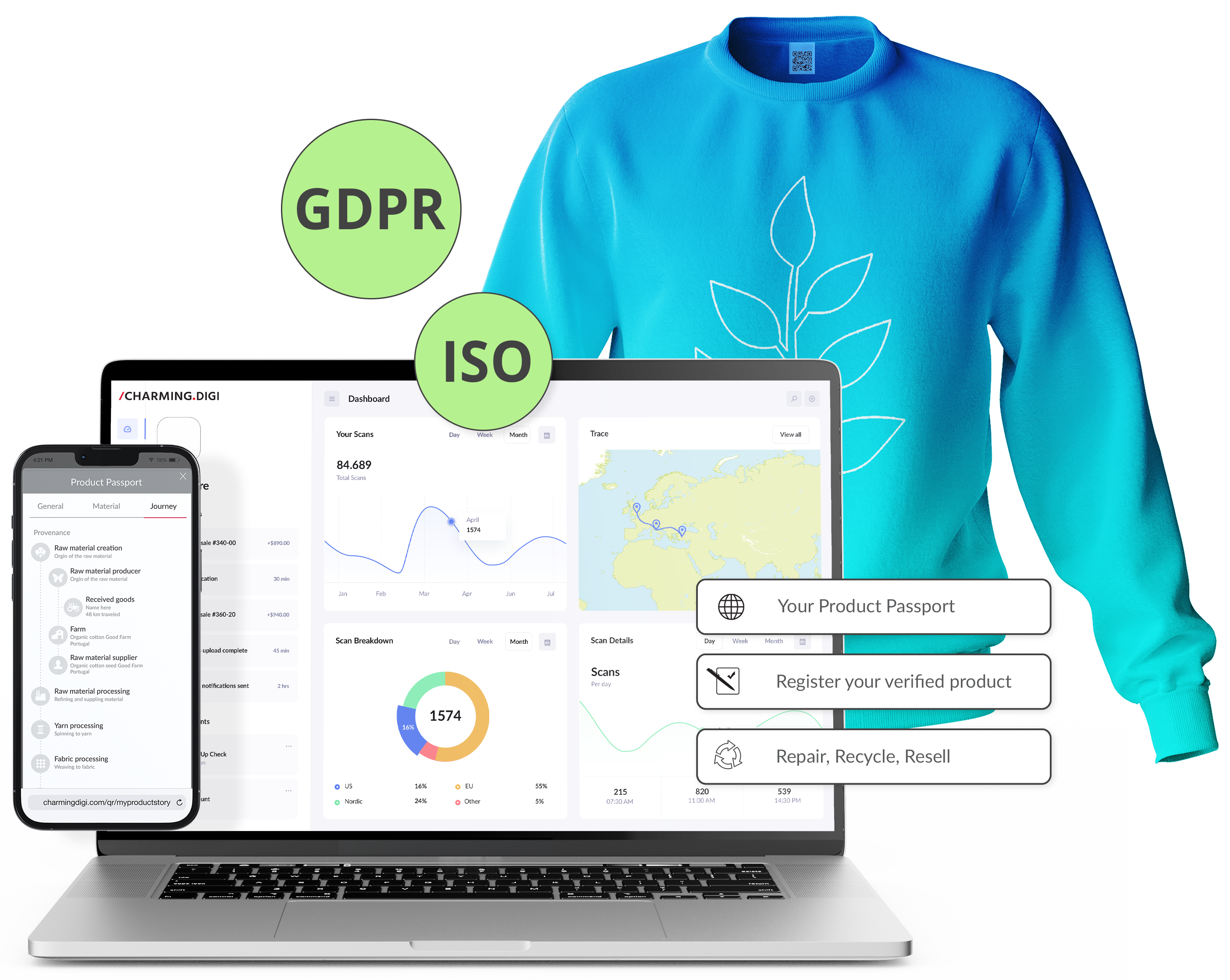
Rather than including directions and information right on the tag, the tag can be a bridge for customers to reach rich information about their garment, its origin, and your company. By using a QR code or NFC tag, your care label can become a portal for branding and compliance, sending customers straight to the information-rich digital product passport (DPP).
Regulatory pressure
As the DPP has developed, brands have waffled about whether or not to take the leap. But in a few years, it won’t be a choice. While California regulations require increased communication with your customers, the EU has passed a specific law that demands companies leverage a digital product passport.
While you won’t need to have a DPP in the next week or two, the timeline isn’t far off. By 2027, companies will need to have a minimal digital product passport and, by 2033, the DPP needs to be fully fleshed out and in-depth.
At the very least, it’s time to get started on DPP development, simply to continue selling to companies in the EU (and very likely, California). But the DPP has far more potential than just checking a compliance box.
Using your care labels to stand out
While the DPP is necessary for meeting emerging regulatory requirements, it has the potential to be a major value-add for your organization. When you guide your customers through a portal, you have a perfect opportunity to tell your brand story—and differentiate from competitors.
Ringeisen recommends taking a look at three key questions to help boost the impact of your care label and your DPP:
- Does your care label & DPP reflect your space in the market and match your marketing?
- Does your care label & DPP help your consumer understand your brand better?
- Is your care label made out of materials that reflect your values?
If you answered, “No,” to any of the above questions, you’re underutilizing your care label’s potential.
How Charming Trim can help
At Charming Trim, we recognize that constantly changing regulations aren’t easy to keep up with. That’s why we’ve made it easy for you to check compliance boxes, both with your physical care labels and your DPP.
With a variety of sustainable materials to choose from for your labels, and a partnership with Tappr that can bring your digital product passport to life, Charming Trim can help you with everything you need to stay compliant and competitive. To learn more about our products, hop on a call with one of our team members.
Ringeisen closed our chat with a final thought: “We’re living in a digital world. Why not prove it?”

.png) CHARMING STAFF
CHARMING STAFF

.png?width=30&name=CT%20SLASH%20(1).png) CHARMING STAFF : Sep 29, 2021, 12:00:00 AM
CHARMING STAFF : Sep 29, 2021, 12:00:00 AM

.png?width=30&name=rich%20ringeisen%20-%20Edited%20(1).png) Rich Ringeisen
Rich Ringeisen